There are several sports that Korea excels at: taekwondo, archery, judo, and weight lifting to name a few. But in athletics, unfortunately, Korea has rarely won medals and accordingly, public interest, too, is rather modest.
But next year, it seems it may be quite different – for the IAAF (International Association of Athletics Federations) World Championships is scheduled to be held in Daegu, Korea from August 27 to September 4. Those who run the fastest, jump the highest, leap the farthest will be all gathering together!
So the 27th of August 2011 is the day it will begin. Following the 1988 Olympics and the 2002 World Cup, this time Korea will host the IAAF Championships, with some ambitious goals set for itself – ranking within top 10 in 10 categories, including marathon, race-walking, hurdles, pole vault, and javelin throws for both male and female.
The organizing committee for the Daegu Championships is working hard to make the event a success. They are repairing and upgrading the Daegu Stadium which will be the main venue for the games, and the Athletes’ Village where the athletes from all over the world will be lodging is scheduled for completion in April 2011. About half has already been completed. Also, some 6,000 supporters are being recruited, including interpreters, assistants and organizers in some 10 specific areas.
Now that slightly less than a year is left till the grand opening, the tickets are on sale both on and offline. The price of the tickets ranges from KRW 10,000 to 150,000 and the season ticket with which you can watch all of the competitions costs from KRW 200,000 to 850,000. The prices are cheaper than the ones at the Osaka Championship in 2007 or Berlin in 2009.
A Mega-Scale Sporting Event
The IAAF Daegu 2011 will be the second time the competition is held in Asia, following the one in Osaka, Japan in 2007.
It will be a mega-scale sporting event where over 6,000 foreigners from 213 countries will visit and participate in 47 different games. Apparently, it is a major opportunity to showcase various attractive aspects of Korea. Apart from the actual visitors, there will also be some 7 billion TV viewers, which will induce an impressive amount of economic value. To host this championship, Korea needs KRW 5.5 trillion’s volume of manufacture, 60 thousand employments, and is expected to generate value-added of 2.3 trillion’s worth.
Hosting a sporting event of this magnitude is certainly no easy job. It requires a lot of resources both finance, energy, time-wise, not to mention a thorough, meticulous planning. The entire world will be watching Korea. So, let’s hope and strive for a successful hosting!
Thursday, October 14, 2010


Perfect Time to Visit National Parks of Korea
The stifling heat of the summer has somewhat simmered down and we can now feel a hint of autumn seeping through the air. If you’re planning an autumn vacation, I’d say you should definitely go for the mountains.
Around this time of a year, Korean mountains exhibit splendid foliage. National parks at such mountains as Seoraksan, Naejangsan, Songnisan and Wolchulsan will be perfect spots for enjoying wonderful Korean autumn sights. In link with this, there is a TV program that introduces beautiful mountain scenery of Korea.
There are around 20 national parks in Korea, all of which boast exceptional natural beauties. 38 million people visit the parks annually, and they are home to some 60% of endangered species. So it’s hardly an overstatement to say national parks are the very core of Korea’s ecology.
In an effort to promote Korean natural sights to the world overseas, the Korea National Park Service produced a TV program that introduces Korea’s national parks in cooperation with Arirang TV, an English-language TV channel that has viewers from more than 188 countries including the US, Canada and the UK via satellite.
In the program, foreign reporters visit the parks and go on “eco-tours”, introducing the sights from the perspective of non-Koreans. For example, at Dadohaehaesang National Park, the largest national park in Korea which expands across seven coastal areas in the South and West Sea, reporters get hands-on experience on drying anchovies, or at Odaesan National Park they get to unearth potatoes.
The program is made up of 20 episodes, each of which is about 10 minutes in length. It will be aired at 7:30 pm (Korean time) every Saturday on Arirang TV.
Various Education & Entertainment Programs
We may think national parks are just nice, peaceful tourist spots with a bunch of mountains and creeks and trees and whatnot bundled up together. Well, maybe so. But recently, many educational and entertaining programs are being offered for those far too many city-bound children and life-jaded adults.
For example, at those national parks near the city such as Bukhansan National Park, they have built an “eco village” where city kids can explore nature, get an education on environment and also receive treatment for environment-related illnesses such as asthma or atopic dermatitis which as many as one quarter of children suffer.
Also, since national parks house many of endangered species, children can take actual glimpses at those precious fauna and flora that they’ve only seen on the pages of books. For example, Byeonsanbando National Park houses the very rare insect “chrysochroa fulgidissima,” or in another term, “jewel beetle.”
So, why not take your autumn vacation at one of these splendid national parks?
Around this time of a year, Korean mountains exhibit splendid foliage. National parks at such mountains as Seoraksan, Naejangsan, Songnisan and Wolchulsan will be perfect spots for enjoying wonderful Korean autumn sights. In link with this, there is a TV program that introduces beautiful mountain scenery of Korea.
There are around 20 national parks in Korea, all of which boast exceptional natural beauties. 38 million people visit the parks annually, and they are home to some 60% of endangered species. So it’s hardly an overstatement to say national parks are the very core of Korea’s ecology.
In an effort to promote Korean natural sights to the world overseas, the Korea National Park Service produced a TV program that introduces Korea’s national parks in cooperation with Arirang TV, an English-language TV channel that has viewers from more than 188 countries including the US, Canada and the UK via satellite.
In the program, foreign reporters visit the parks and go on “eco-tours”, introducing the sights from the perspective of non-Koreans. For example, at Dadohaehaesang National Park, the largest national park in Korea which expands across seven coastal areas in the South and West Sea, reporters get hands-on experience on drying anchovies, or at Odaesan National Park they get to unearth potatoes.
The program is made up of 20 episodes, each of which is about 10 minutes in length. It will be aired at 7:30 pm (Korean time) every Saturday on Arirang TV.
Various Education & Entertainment Programs
We may think national parks are just nice, peaceful tourist spots with a bunch of mountains and creeks and trees and whatnot bundled up together. Well, maybe so. But recently, many educational and entertaining programs are being offered for those far too many city-bound children and life-jaded adults.
For example, at those national parks near the city such as Bukhansan National Park, they have built an “eco village” where city kids can explore nature, get an education on environment and also receive treatment for environment-related illnesses such as asthma or atopic dermatitis which as many as one quarter of children suffer.
Also, since national parks house many of endangered species, children can take actual glimpses at those precious fauna and flora that they’ve only seen on the pages of books. For example, Byeonsanbando National Park houses the very rare insect “chrysochroa fulgidissima,” or in another term, “jewel beetle.”
So, why not take your autumn vacation at one of these splendid national parks?
Sunday, August 15, 2010
Two Korean Villages Become UNESCO Sites
Andong City’s Hahoe Village and Gyeongju City’s Yangdong Village, which are the two most representative historic villages in Korea, were registered on the UNESCO World Cultural Heritage list at the 34th Session of the World Heritage Committee (WHC) held in Brasilia, Brazil on August 1. With this designation, Korea now holds a total of 10 UNESCO World Heritage items.
It is extremely rare for historic villages to be in intact state due to modernization and development and such, and the assessment of the International Council on Monuments and Sites (ICOMOS) is accordingly extremely rigorous.
The Hahoe and Yangdong Village, too, had to go through a series of reviews, holdups, and postponements before they were granted the approval. ICOMOS recognized the two villages’ historic and cultural significance as early as last May and the legitimate ground in having them registered as one coupled-up item. However, due to the fact that there wasn’t a comprehensive administrative office that manages both of the villages together, ICOMOS sustained their approval.
To this, Korea’s Cultural Heritage Administration with Gyeongsangbuk-do, Andong City and Gyeongju City, organized “The Council on Preservation of Historic Villages” that was going to collaboratively manage and preserve the two villages. And after submitting to 21 member countries of WHC thorough information and promotional materials on the Hahoe and Yangdong Village as well as dispatching a government delegation to the 34th Session of WHC, were they able to put the two villages on the list of UNECO World Cultural Heritage.
1995: Seokguram Grotto and Bulguksa Temple / Jongmyo Shrine / Haeinsa Temple Janggyeong Panjeon, the Depositories for the Tripitaka Koreana Woodblocks
1997: Changdeokgung Palace Complex / Hwaseong Fortress
2000: Gyeongju Historic Areas / Gochang, Hwasun and Ganghwa Dolmen Sites
2007: Jeju Volcanic Island and Lava Tubes
2009: Royal Tombs of the Joseon Dynasty
2010: Historic Villages of Korea: Hahoe and Yangdong
Founded in the 14th-15th centuries, Hahoe and Yangdong Village’s layout and location – sheltered by forested mountains and facing out onto a river and open agricultural fields – reflect the distinctive aristocratic Confucian culture of the early part of the Joseon Dynasty (1392-1910).
The Hahoe Village contains Yangjindang Manor (Treasure No. 306), Pikchondaek House (Important Folklore Material No. 84), Chunghyodang Manor (Treasure No. 414), and Namchondaek House (Important Folklore Material No. 90) among others. It has also preserved the shamanist rite of Byeolsin-gut, Hahoe Mask Dance, and Jeulbul Nori.
The Yangdong Village contains Mucheomdang (Treasure No. 411), Hyangdan (Treasure No. 412), Gwangajeong (Treasure No. 442) as well as Tonggamsokpyeon, a book printed on movable metal type (National Treasure No. 283).
The two villages are the first of their kind in Korea to receive the honor in that they are places that are actually being inhabited by people. They are “living heritage.” Residents have well preserved not only traditional housings but the intangible culture of the two villages as well, which further increases the value of Hahoe and Yangdong.
Having relics registered on the UNESCO list is pointless if they don’t continue to be properly looked after. The two villages, Hahoe and Yangdong, now having become world-acknowledged historic assets, will likely trigger a surge of tourists both domestic and international. And accordingly, we will need to further reinforce maintenance system and strengthen tourism infrastructure so that those precious vestiges of the past can still be there for the next generation to appreciate as well.
(Source: http://blog.naver.com/korea_brand/10091981377)
It is extremely rare for historic villages to be in intact state due to modernization and development and such, and the assessment of the International Council on Monuments and Sites (ICOMOS) is accordingly extremely rigorous.
The Hahoe and Yangdong Village, too, had to go through a series of reviews, holdups, and postponements before they were granted the approval. ICOMOS recognized the two villages’ historic and cultural significance as early as last May and the legitimate ground in having them registered as one coupled-up item. However, due to the fact that there wasn’t a comprehensive administrative office that manages both of the villages together, ICOMOS sustained their approval.
To this, Korea’s Cultural Heritage Administration with Gyeongsangbuk-do, Andong City and Gyeongju City, organized “The Council on Preservation of Historic Villages” that was going to collaboratively manage and preserve the two villages. And after submitting to 21 member countries of WHC thorough information and promotional materials on the Hahoe and Yangdong Village as well as dispatching a government delegation to the 34th Session of WHC, were they able to put the two villages on the list of UNECO World Cultural Heritage.
1995: Seokguram Grotto and Bulguksa Temple / Jongmyo Shrine / Haeinsa Temple Janggyeong Panjeon, the Depositories for the Tripitaka Koreana Woodblocks
1997: Changdeokgung Palace Complex / Hwaseong Fortress
2000: Gyeongju Historic Areas / Gochang, Hwasun and Ganghwa Dolmen Sites
2007: Jeju Volcanic Island and Lava Tubes
2009: Royal Tombs of the Joseon Dynasty
2010: Historic Villages of Korea: Hahoe and Yangdong
Founded in the 14th-15th centuries, Hahoe and Yangdong Village’s layout and location – sheltered by forested mountains and facing out onto a river and open agricultural fields – reflect the distinctive aristocratic Confucian culture of the early part of the Joseon Dynasty (1392-1910).
The Hahoe Village contains Yangjindang Manor (Treasure No. 306), Pikchondaek House (Important Folklore Material No. 84), Chunghyodang Manor (Treasure No. 414), and Namchondaek House (Important Folklore Material No. 90) among others. It has also preserved the shamanist rite of Byeolsin-gut, Hahoe Mask Dance, and Jeulbul Nori.
The Yangdong Village contains Mucheomdang (Treasure No. 411), Hyangdan (Treasure No. 412), Gwangajeong (Treasure No. 442) as well as Tonggamsokpyeon, a book printed on movable metal type (National Treasure No. 283).
The two villages are the first of their kind in Korea to receive the honor in that they are places that are actually being inhabited by people. They are “living heritage.” Residents have well preserved not only traditional housings but the intangible culture of the two villages as well, which further increases the value of Hahoe and Yangdong.
Having relics registered on the UNESCO list is pointless if they don’t continue to be properly looked after. The two villages, Hahoe and Yangdong, now having become world-acknowledged historic assets, will likely trigger a surge of tourists both domestic and international. And accordingly, we will need to further reinforce maintenance system and strengthen tourism infrastructure so that those precious vestiges of the past can still be there for the next generation to appreciate as well.
(Source: http://blog.naver.com/korea_brand/10091981377)
Monday, July 26, 2010
University Computer Center, SNU : Wow great service
The service provided by university computer center (UCC) was too great that I think to dedicate few pages for the university service.
Recently, my laptop had some error and did not start at all. I tried all permutation and combination to start it but failed and hence approached UCC. Here UCC is very systematically developed and quite possible in other universities of developed country must be better than here, however for me it was great service.
They loaned all licensed soft wares including SAS, SPSS, Office etc which is greatly helpful to the students. They have very quick service to reach to the destination (big campuses like SNU about 2 - 3 sq km)and solve the problem especially for networking issues even in dormitory. The UCC have many good staff interestingly from 9 to 9 and not 9 to 6 and even in Saturday.Is it not great service?
I think it provide excellent service to the student community. their service also include data extraction from the hard disk, and all services are free. great !!!
Not only SNU, UCC but lets see for example the services of SNU library is also great. It provides good number of books, journals etc beside this it has very good system to buy books and even data set (like census data) in very reasonable time.
Both services of SNU - UCC and Library help greatly to more dedication in research.
Thanks to University Computer Center and University Library, Seoul National University
Recently, my laptop had some error and did not start at all. I tried all permutation and combination to start it but failed and hence approached UCC. Here UCC is very systematically developed and quite possible in other universities of developed country must be better than here, however for me it was great service.
They loaned all licensed soft wares including SAS, SPSS, Office etc which is greatly helpful to the students. They have very quick service to reach to the destination (big campuses like SNU about 2 - 3 sq km)and solve the problem especially for networking issues even in dormitory. The UCC have many good staff interestingly from 9 to 9 and not 9 to 6 and even in Saturday.Is it not great service?
I think it provide excellent service to the student community. their service also include data extraction from the hard disk, and all services are free. great !!!
Not only SNU, UCC but lets see for example the services of SNU library is also great. It provides good number of books, journals etc beside this it has very good system to buy books and even data set (like census data) in very reasonable time.
Both services of SNU - UCC and Library help greatly to more dedication in research.
Thanks to University Computer Center and University Library, Seoul National University
Monday, July 19, 2010
11th APRU Conference, Jakarta
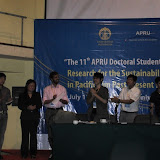
Here is some photographs from 11th APRU conference, Jakarta. I hope to write some detail about Jakarta in general and conference in particular later (If time permit me) . Now it is hard time to concentrate on writing thesis.
Monday, June 28, 2010
Excursion to Ulleungdo and Dokdo 21-23 June, 2010
I was enough lucky to get invited to experience Korean ecological environment and culture by the Korean National Council for Conservation of Nature (KNCCN) on part of people-to-people diplomacy in Ulleungdo and Dokdo. This trip was organized from 21-23 June, 2010. I was part of about 100 international students, therefore besides ecological understanding; it also provided a good platform to meet with friends across the world.
Ulleungdo is an island, located in eastern side of Korea, about 161 KM from Mukho ferry terminal. Dokdo islet is further about 84 KM eastern side of Ulleungdo. First, we visited Ulleungdo and the same day we tour for local places notably the museum, and the very next day we took ferry and did excursion of Dokdo islet and finally on the third day we visited many places in Ulleungdo and toured many villages and beautiful sightseeing at there. This writing tells some observations about this wonderful trip.
No doubt both places are worth to visit in perspective of exploring ecological and cultural environment in addition to its geo-political setting. I had a unique opportunity to travel so long by water way i.e. ferry and experienced differences with road/air travelling. Ferry travelling is very much dependent on the weather condition, hence an important predictors of duration and destination. For example, the ferry used to go to Dokdo islet hardly 50 days in a year due to whether condition. Moreover, I felt a different kind of interest but a monotonous scene of sea.
The way of evolving human settlements is also interesting at Ulleungdo. In present context, it is similar to dream to reside on the moon. The chronological evolution of settlement is very interesting for me which can be found in many resources including handbook provided by the Dokdo museum in Ulleungdo. In brief, the political processes and numerous studies by kingdoms to know its habitation holding capability etc made possible to settle very few (about 50 families) to nearly 10, 000 population now. The process of evolution of governance is also appreciable. At the present moment, the village setting of Ulleungdo may be some of the best in the world; however the urban setting is unlike to the development of Korea. The core area especially, ferry terminal area demands for immediate planning intervention to restore natural fabric and enhance ecological environment.
Dokdo islet experienced was also great. We stayed hardly half hour. I wish I would have stayed some more time there and would have landed on the islet. Although, short stay at the Dokdo, permit us to see rich flora and fauna and interesting forms of islets.
I would like to thanks staffs of the KNCCN for arranging this wonderful trip.
Ulleungdo is an island, located in eastern side of Korea, about 161 KM from Mukho ferry terminal. Dokdo islet is further about 84 KM eastern side of Ulleungdo. First, we visited Ulleungdo and the same day we tour for local places notably the museum, and the very next day we took ferry and did excursion of Dokdo islet and finally on the third day we visited many places in Ulleungdo and toured many villages and beautiful sightseeing at there. This writing tells some observations about this wonderful trip.
No doubt both places are worth to visit in perspective of exploring ecological and cultural environment in addition to its geo-political setting. I had a unique opportunity to travel so long by water way i.e. ferry and experienced differences with road/air travelling. Ferry travelling is very much dependent on the weather condition, hence an important predictors of duration and destination. For example, the ferry used to go to Dokdo islet hardly 50 days in a year due to whether condition. Moreover, I felt a different kind of interest but a monotonous scene of sea.
The way of evolving human settlements is also interesting at Ulleungdo. In present context, it is similar to dream to reside on the moon. The chronological evolution of settlement is very interesting for me which can be found in many resources including handbook provided by the Dokdo museum in Ulleungdo. In brief, the political processes and numerous studies by kingdoms to know its habitation holding capability etc made possible to settle very few (about 50 families) to nearly 10, 000 population now. The process of evolution of governance is also appreciable. At the present moment, the village setting of Ulleungdo may be some of the best in the world; however the urban setting is unlike to the development of Korea. The core area especially, ferry terminal area demands for immediate planning intervention to restore natural fabric and enhance ecological environment.
Dokdo islet experienced was also great. We stayed hardly half hour. I wish I would have stayed some more time there and would have landed on the islet. Although, short stay at the Dokdo, permit us to see rich flora and fauna and interesting forms of islets.
I would like to thanks staffs of the KNCCN for arranging this wonderful trip.
Thursday, June 3, 2010
Asian University Conference for Green Leadership, Seoul National University
A day conference hosted by Asian Institute of Energy Environment and Sustainability (AIEES), Seoul National University dealt with the upcoming methodology for fostering leadership especially through undergraduate studies.
Representation from Japan, China, Singapore and of course Korea was representative of Asian brand. The discussion was intense and at least there was consensus for creating a brand leadership in the next generation.
Seoul National University program, in which they want to develop few courses for environmental science cross cutting to science, social science, engineering and others area in which if an undergraduate student will opt for 3-4 courses then an undergraduate student can get a certificate of green leader certified by certain central ministry in addition to the undergraduate degree.
I hope in future these kind of subjects will be very interesting and demanding both by market as well as by the world.
If time permit, I will write in detail, later !
Representation from Japan, China, Singapore and of course Korea was representative of Asian brand. The discussion was intense and at least there was consensus for creating a brand leadership in the next generation.
Seoul National University program, in which they want to develop few courses for environmental science cross cutting to science, social science, engineering and others area in which if an undergraduate student will opt for 3-4 courses then an undergraduate student can get a certificate of green leader certified by certain central ministry in addition to the undergraduate degree.
I hope in future these kind of subjects will be very interesting and demanding both by market as well as by the world.
If time permit, I will write in detail, later !
Subscribe to:
Posts (Atom)
