Andong City’s Hahoe Village and Gyeongju City’s Yangdong Village, which are the two most representative historic villages in Korea, were registered on the UNESCO World Cultural Heritage list at the 34th Session of the World Heritage Committee (WHC) held in Brasilia, Brazil on August 1. With this designation, Korea now holds a total of 10 UNESCO World Heritage items.
It is extremely rare for historic villages to be in intact state due to modernization and development and such, and the assessment of the International Council on Monuments and Sites (ICOMOS) is accordingly extremely rigorous.
The Hahoe and Yangdong Village, too, had to go through a series of reviews, holdups, and postponements before they were granted the approval. ICOMOS recognized the two villages’ historic and cultural significance as early as last May and the legitimate ground in having them registered as one coupled-up item. However, due to the fact that there wasn’t a comprehensive administrative office that manages both of the villages together, ICOMOS sustained their approval.
To this, Korea’s Cultural Heritage Administration with Gyeongsangbuk-do, Andong City and Gyeongju City, organized “The Council on Preservation of Historic Villages” that was going to collaboratively manage and preserve the two villages. And after submitting to 21 member countries of WHC thorough information and promotional materials on the Hahoe and Yangdong Village as well as dispatching a government delegation to the 34th Session of WHC, were they able to put the two villages on the list of UNECO World Cultural Heritage.
1995: Seokguram Grotto and Bulguksa Temple / Jongmyo Shrine / Haeinsa Temple Janggyeong Panjeon, the Depositories for the Tripitaka Koreana Woodblocks
1997: Changdeokgung Palace Complex / Hwaseong Fortress
2000: Gyeongju Historic Areas / Gochang, Hwasun and Ganghwa Dolmen Sites
2007: Jeju Volcanic Island and Lava Tubes
2009: Royal Tombs of the Joseon Dynasty
2010: Historic Villages of Korea: Hahoe and Yangdong
Founded in the 14th-15th centuries, Hahoe and Yangdong Village’s layout and location – sheltered by forested mountains and facing out onto a river and open agricultural fields – reflect the distinctive aristocratic Confucian culture of the early part of the Joseon Dynasty (1392-1910).
The Hahoe Village contains Yangjindang Manor (Treasure No. 306), Pikchondaek House (Important Folklore Material No. 84), Chunghyodang Manor (Treasure No. 414), and Namchondaek House (Important Folklore Material No. 90) among others. It has also preserved the shamanist rite of Byeolsin-gut, Hahoe Mask Dance, and Jeulbul Nori.
The Yangdong Village contains Mucheomdang (Treasure No. 411), Hyangdan (Treasure No. 412), Gwangajeong (Treasure No. 442) as well as Tonggamsokpyeon, a book printed on movable metal type (National Treasure No. 283).
The two villages are the first of their kind in Korea to receive the honor in that they are places that are actually being inhabited by people. They are “living heritage.” Residents have well preserved not only traditional housings but the intangible culture of the two villages as well, which further increases the value of Hahoe and Yangdong.
Having relics registered on the UNESCO list is pointless if they don’t continue to be properly looked after. The two villages, Hahoe and Yangdong, now having become world-acknowledged historic assets, will likely trigger a surge of tourists both domestic and international. And accordingly, we will need to further reinforce maintenance system and strengthen tourism infrastructure so that those precious vestiges of the past can still be there for the next generation to appreciate as well.
(Source: http://blog.naver.com/korea_brand/10091981377)
Sunday, August 15, 2010


Monday, July 26, 2010
University Computer Center, SNU : Wow great service
The service provided by university computer center (UCC) was too great that I think to dedicate few pages for the university service.
Recently, my laptop had some error and did not start at all. I tried all permutation and combination to start it but failed and hence approached UCC. Here UCC is very systematically developed and quite possible in other universities of developed country must be better than here, however for me it was great service.
They loaned all licensed soft wares including SAS, SPSS, Office etc which is greatly helpful to the students. They have very quick service to reach to the destination (big campuses like SNU about 2 - 3 sq km)and solve the problem especially for networking issues even in dormitory. The UCC have many good staff interestingly from 9 to 9 and not 9 to 6 and even in Saturday.Is it not great service?
I think it provide excellent service to the student community. their service also include data extraction from the hard disk, and all services are free. great !!!
Not only SNU, UCC but lets see for example the services of SNU library is also great. It provides good number of books, journals etc beside this it has very good system to buy books and even data set (like census data) in very reasonable time.
Both services of SNU - UCC and Library help greatly to more dedication in research.
Thanks to University Computer Center and University Library, Seoul National University
Recently, my laptop had some error and did not start at all. I tried all permutation and combination to start it but failed and hence approached UCC. Here UCC is very systematically developed and quite possible in other universities of developed country must be better than here, however for me it was great service.
They loaned all licensed soft wares including SAS, SPSS, Office etc which is greatly helpful to the students. They have very quick service to reach to the destination (big campuses like SNU about 2 - 3 sq km)and solve the problem especially for networking issues even in dormitory. The UCC have many good staff interestingly from 9 to 9 and not 9 to 6 and even in Saturday.Is it not great service?
I think it provide excellent service to the student community. their service also include data extraction from the hard disk, and all services are free. great !!!
Not only SNU, UCC but lets see for example the services of SNU library is also great. It provides good number of books, journals etc beside this it has very good system to buy books and even data set (like census data) in very reasonable time.
Both services of SNU - UCC and Library help greatly to more dedication in research.
Thanks to University Computer Center and University Library, Seoul National University
Monday, July 19, 2010
11th APRU Conference, Jakarta
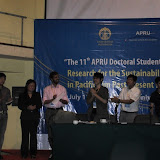
Here is some photographs from 11th APRU conference, Jakarta. I hope to write some detail about Jakarta in general and conference in particular later (If time permit me) . Now it is hard time to concentrate on writing thesis.
Monday, June 28, 2010
Excursion to Ulleungdo and Dokdo 21-23 June, 2010
I was enough lucky to get invited to experience Korean ecological environment and culture by the Korean National Council for Conservation of Nature (KNCCN) on part of people-to-people diplomacy in Ulleungdo and Dokdo. This trip was organized from 21-23 June, 2010. I was part of about 100 international students, therefore besides ecological understanding; it also provided a good platform to meet with friends across the world.
Ulleungdo is an island, located in eastern side of Korea, about 161 KM from Mukho ferry terminal. Dokdo islet is further about 84 KM eastern side of Ulleungdo. First, we visited Ulleungdo and the same day we tour for local places notably the museum, and the very next day we took ferry and did excursion of Dokdo islet and finally on the third day we visited many places in Ulleungdo and toured many villages and beautiful sightseeing at there. This writing tells some observations about this wonderful trip.
No doubt both places are worth to visit in perspective of exploring ecological and cultural environment in addition to its geo-political setting. I had a unique opportunity to travel so long by water way i.e. ferry and experienced differences with road/air travelling. Ferry travelling is very much dependent on the weather condition, hence an important predictors of duration and destination. For example, the ferry used to go to Dokdo islet hardly 50 days in a year due to whether condition. Moreover, I felt a different kind of interest but a monotonous scene of sea.
The way of evolving human settlements is also interesting at Ulleungdo. In present context, it is similar to dream to reside on the moon. The chronological evolution of settlement is very interesting for me which can be found in many resources including handbook provided by the Dokdo museum in Ulleungdo. In brief, the political processes and numerous studies by kingdoms to know its habitation holding capability etc made possible to settle very few (about 50 families) to nearly 10, 000 population now. The process of evolution of governance is also appreciable. At the present moment, the village setting of Ulleungdo may be some of the best in the world; however the urban setting is unlike to the development of Korea. The core area especially, ferry terminal area demands for immediate planning intervention to restore natural fabric and enhance ecological environment.
Dokdo islet experienced was also great. We stayed hardly half hour. I wish I would have stayed some more time there and would have landed on the islet. Although, short stay at the Dokdo, permit us to see rich flora and fauna and interesting forms of islets.
I would like to thanks staffs of the KNCCN for arranging this wonderful trip.
Ulleungdo is an island, located in eastern side of Korea, about 161 KM from Mukho ferry terminal. Dokdo islet is further about 84 KM eastern side of Ulleungdo. First, we visited Ulleungdo and the same day we tour for local places notably the museum, and the very next day we took ferry and did excursion of Dokdo islet and finally on the third day we visited many places in Ulleungdo and toured many villages and beautiful sightseeing at there. This writing tells some observations about this wonderful trip.
No doubt both places are worth to visit in perspective of exploring ecological and cultural environment in addition to its geo-political setting. I had a unique opportunity to travel so long by water way i.e. ferry and experienced differences with road/air travelling. Ferry travelling is very much dependent on the weather condition, hence an important predictors of duration and destination. For example, the ferry used to go to Dokdo islet hardly 50 days in a year due to whether condition. Moreover, I felt a different kind of interest but a monotonous scene of sea.
The way of evolving human settlements is also interesting at Ulleungdo. In present context, it is similar to dream to reside on the moon. The chronological evolution of settlement is very interesting for me which can be found in many resources including handbook provided by the Dokdo museum in Ulleungdo. In brief, the political processes and numerous studies by kingdoms to know its habitation holding capability etc made possible to settle very few (about 50 families) to nearly 10, 000 population now. The process of evolution of governance is also appreciable. At the present moment, the village setting of Ulleungdo may be some of the best in the world; however the urban setting is unlike to the development of Korea. The core area especially, ferry terminal area demands for immediate planning intervention to restore natural fabric and enhance ecological environment.
Dokdo islet experienced was also great. We stayed hardly half hour. I wish I would have stayed some more time there and would have landed on the islet. Although, short stay at the Dokdo, permit us to see rich flora and fauna and interesting forms of islets.
I would like to thanks staffs of the KNCCN for arranging this wonderful trip.
Thursday, June 3, 2010
Asian University Conference for Green Leadership, Seoul National University
A day conference hosted by Asian Institute of Energy Environment and Sustainability (AIEES), Seoul National University dealt with the upcoming methodology for fostering leadership especially through undergraduate studies.
Representation from Japan, China, Singapore and of course Korea was representative of Asian brand. The discussion was intense and at least there was consensus for creating a brand leadership in the next generation.
Seoul National University program, in which they want to develop few courses for environmental science cross cutting to science, social science, engineering and others area in which if an undergraduate student will opt for 3-4 courses then an undergraduate student can get a certificate of green leader certified by certain central ministry in addition to the undergraduate degree.
I hope in future these kind of subjects will be very interesting and demanding both by market as well as by the world.
If time permit, I will write in detail, later !
Representation from Japan, China, Singapore and of course Korea was representative of Asian brand. The discussion was intense and at least there was consensus for creating a brand leadership in the next generation.
Seoul National University program, in which they want to develop few courses for environmental science cross cutting to science, social science, engineering and others area in which if an undergraduate student will opt for 3-4 courses then an undergraduate student can get a certificate of green leader certified by certain central ministry in addition to the undergraduate degree.
I hope in future these kind of subjects will be very interesting and demanding both by market as well as by the world.
If time permit, I will write in detail, later !
Sunday, May 23, 2010
Seoul has lessons for India on Games
With Commonwealth Games (CWG) tickets going on sale from June 1, it may be worth assessing how the host country benefits from holding events such as the World Cup, Olympics or Asian Games. They attract millions. There are spectators and thousands of players, officials and journalists. The visitors contribute to the local economy every time they pay for accommodation, travel and shopping. Some visitors may also see business opportunities and end up engaging in trade and commerce with the host country.
Equally crucial is the image the visitors take back of the host country. They virtually become brand ambassadors for the country they have visited. If a wider positive impression is created by word of mouth, it could mean the influx of millions of tourists from different parts of the globe. All of this builds a global brand image of the host country.
So immense is the scope for infrastructure creation, revenue-generation and image-building in the short and long term that countries do not want to miss out the opportunity to play host. The South Koreans developed many parts of their country in a planned and strategic manner by hosting the 1988 Olympic Games in different places. The initial events were in Seoul, then in Busan. The 2014 Asian Games will be in Incheon. Such an approach helps develop the whole country using the funds given to sporting events. It creates infrastructure, helps employment and can enhance the agenda for inclusive growth.
But for India, it has been a case of missed opportunities. New Delhi has not been able to use these Games – and others – strategically to develop different parts of the country. From the first Asian Games in 1951 to their 1982 edition, from the 2010 hockey World Cup to the CWG, the venue has always been Delhi.
Even so, India could still derive significant benefits from the CWG. It could capitalize on the global attention its economy is getting. It could showcase itself by attempting to achieve the following: One, create proper infrastructure. Two, ensure the Games are incident-free by putting in place an effective security and disaster management plan. Three, plan cultural events in select destinations. Four, create special-focus tourism zones, which could include Agra, Jaipur, Varanasi and Kulu Manali.
Each objective requires a task force that integrates seamlessly with others. National prestige is involved so India’s political leadership should put aside its differences and work jointly to ensure the Games are a resounding success.
Security threats are the main concern in this part of the world, so it is high time everyone – from the home ministry to state governments to the ordinary citizen – gears up to face the challenge.
Creating special focus tourism zones would require a multipronged approach. It would include the facelift/maintenance of monuments, proper infrastructure development and a foolproof security structure. Planned cultural and culinary events and handicraft expos would go a long way towards attracting tourists. In addition, the National Cadet Corps and college students could be trained to create tourist awareness among the public. Special drives to encourage artisans and fine arts institutions could help produce handicrafts and innovative souvenirs to be sold exclusively during the CWG.
Handling tourists in large numbers involves planning. For the ‘pretrip’ phase, communication campaigns should be backed up with easy-to-use tourist websites. Payment gateways should be created to enable secure online payments. The ‘frequently asked questions’ section of tourism websites must be revamped. During the ‘trip’ phase, the role of designing mini-visits within the overall itinerary will be of immense importance. In the ‘posttrip’ phase, feedback and planning for future trips is required.
It would also be essential to maintain high standards of airport and flight management and a comprehensive anti-terror blueprint including coordination with international intelligence agencies. This would need multi-tier agency coordination. It is important there is no electricity grid failure. Disaster plans need to be chalked out. Media and PR management will be critical. So will be controlling pollution (air, water and noise) in line with international standards.
Tourist experiences linger on as memories, which can be built by events. They can be of two types – those that are associated with the history of the destination city and the second with events characterizing the general region visited. For instance, a host of events can be organized at Agra, such as light and sound shows at the Agra Fort, concerts on the banks of the Yamuna, handicrafts fairs, Mughlai food festivals in major hotels, night markets selling souvenirs, replays of Barsana Holi in Mathura or musical soirees that offer glimpses of Indian culture. Dramatizing historical events at Fatehpur Sikri or a diving show at Buland Darwaza would fascinate tourists.It would make for a unique experience – for tourists and the host country alike.
Source: DEVASHISH DASGUPTA, associate professor of marketing, Indian Institute of Management, Lucknow
Equally crucial is the image the visitors take back of the host country. They virtually become brand ambassadors for the country they have visited. If a wider positive impression is created by word of mouth, it could mean the influx of millions of tourists from different parts of the globe. All of this builds a global brand image of the host country.
So immense is the scope for infrastructure creation, revenue-generation and image-building in the short and long term that countries do not want to miss out the opportunity to play host. The South Koreans developed many parts of their country in a planned and strategic manner by hosting the 1988 Olympic Games in different places. The initial events were in Seoul, then in Busan. The 2014 Asian Games will be in Incheon. Such an approach helps develop the whole country using the funds given to sporting events. It creates infrastructure, helps employment and can enhance the agenda for inclusive growth.
But for India, it has been a case of missed opportunities. New Delhi has not been able to use these Games – and others – strategically to develop different parts of the country. From the first Asian Games in 1951 to their 1982 edition, from the 2010 hockey World Cup to the CWG, the venue has always been Delhi.
Even so, India could still derive significant benefits from the CWG. It could capitalize on the global attention its economy is getting. It could showcase itself by attempting to achieve the following: One, create proper infrastructure. Two, ensure the Games are incident-free by putting in place an effective security and disaster management plan. Three, plan cultural events in select destinations. Four, create special-focus tourism zones, which could include Agra, Jaipur, Varanasi and Kulu Manali.
Each objective requires a task force that integrates seamlessly with others. National prestige is involved so India’s political leadership should put aside its differences and work jointly to ensure the Games are a resounding success.
Security threats are the main concern in this part of the world, so it is high time everyone – from the home ministry to state governments to the ordinary citizen – gears up to face the challenge.
Creating special focus tourism zones would require a multipronged approach. It would include the facelift/maintenance of monuments, proper infrastructure development and a foolproof security structure. Planned cultural and culinary events and handicraft expos would go a long way towards attracting tourists. In addition, the National Cadet Corps and college students could be trained to create tourist awareness among the public. Special drives to encourage artisans and fine arts institutions could help produce handicrafts and innovative souvenirs to be sold exclusively during the CWG.
Handling tourists in large numbers involves planning. For the ‘pretrip’ phase, communication campaigns should be backed up with easy-to-use tourist websites. Payment gateways should be created to enable secure online payments. The ‘frequently asked questions’ section of tourism websites must be revamped. During the ‘trip’ phase, the role of designing mini-visits within the overall itinerary will be of immense importance. In the ‘posttrip’ phase, feedback and planning for future trips is required.
It would also be essential to maintain high standards of airport and flight management and a comprehensive anti-terror blueprint including coordination with international intelligence agencies. This would need multi-tier agency coordination. It is important there is no electricity grid failure. Disaster plans need to be chalked out. Media and PR management will be critical. So will be controlling pollution (air, water and noise) in line with international standards.
Tourist experiences linger on as memories, which can be built by events. They can be of two types – those that are associated with the history of the destination city and the second with events characterizing the general region visited. For instance, a host of events can be organized at Agra, such as light and sound shows at the Agra Fort, concerts on the banks of the Yamuna, handicrafts fairs, Mughlai food festivals in major hotels, night markets selling souvenirs, replays of Barsana Holi in Mathura or musical soirees that offer glimpses of Indian culture. Dramatizing historical events at Fatehpur Sikri or a diving show at Buland Darwaza would fascinate tourists.It would make for a unique experience – for tourists and the host country alike.
Source: DEVASHISH DASGUPTA, associate professor of marketing, Indian Institute of Management, Lucknow
Sunday, May 16, 2010
Changing Seoul for more foreign friendly
This is a well written statement about making Seoul more foreign friendly. I hope, based on the given statistics (http://blog.naver.com/korea_brand/10086193376), Seoul will be friendlier than ever. I am presenting the very same text for disseminate to make informed decision among foreigners.
According to the recent statistics of the Seoul Metropolitan Government, the number of foreign residents of Seoul is estimated at around 250,000 taking up 2.5% of Seoul’s total population. This is an increase by 100,000 people within the last 3 years – a stupendous increase, indeed. This signifies just how fast Seoul is turning into a global and multicultural city. Then how satisfied are the over 250,000 international residents living in Seoul? According to the survey conducted in November 2009 on foreigners who had been living in Seoul for more than one year, their degree of satisfaction scored 3.8 out of 5 points, which is an increase for three consecutive years. But of course, there are things to be improved. To that end, Seoul city has launched the “Happy City Project” which includes various support programs for foreigners in communication, multiculturalism, solving everyday problems and obstacles, and so on. The project focuses on 15 foreigner-dense areas designated as “Global Zones” which include the Seoul City Hall area, Yeoksam, Samsung, Yeouido, Ichon, Itaewon, Hannam, Yeonnam, Seorae Village, Myeongdong, Insadong, Namdaemun, Dongdaemun, etc. Also the construction of the “Global Cluster Building” will begin in May, which will include a one-stop help center for foreigners and chamber of commerce offices of various countries. The “Global Business Help Center” will open in mid-May in COEX with the aim to help foreigners set up small to medium-sized businesses in Korea. And the on-site consultation service, where a batch of staff visits areas with high concentrations of foreigners, will be further streamlined.
Last January, 14 additional multicultural family support centers opened in Seoul, which makes a total of 20 such centers. A web site (http://mcfamily.seoul.go.kr) designed to provide information on Seoul city and job vacancies for foreign spouses was launched in five languages including Chinese, Japanese, Vietnamese, English and Korean. A support center for migrant workers has also been operating, providing Korean-language classes that put focus on industrial site-related vocabulary. There is also the International Student Forum, and the foreign students support desks at major universities that provide counseling and information on Korea for international students. Various cultural performances will take place in Mugyo-dong “Global Street” near the Seoul City Hall, and flea markets for foreigners will be held at the Seoul Folk Flea Market in Sinseol-dong. Furthermore, the Seoul Help Center for Foreigners is going to sponsor 16 foreign community festivals including the Mongolian Naadam Festival and the Irish Folk Dance Festival. For medical services, the current 11 medical centers for foreigners will be expanded to 17 by 2012, and a Global Open Health Center will be launched in Yeongdeungpo-gu and Geumcheon-gu districts in May, where treatments for pregnant women and infants from multicultural families will be provided.
Subscribe to:
Posts (Atom)

